
The Neural Artifacts // Entry 01
The Olfactory Bypass: Why Scent Remembers Before You Do
Have you ever been abruptly stopped in your tracks by a breath of air?
Perhaps you were walking through a quiet space/corner or unboxing tucked-away-coat, and before your conscious mind could even process what was happening, your throat tightened. Or perhaps, just as suddenly, a wave of profound, inexplicable safety washed over you.
Long before you can articulate the note—long before you can say "that is the scent of warm rice steeping," or "that is the exact depth of aged tree resin"—your body has already traveled back in time. Your heart rate shifts. Your muscles loosen or tense. Your nervous system responds to the air before your intellect even gets a chance to speak.
When an emotional memory is retrieved through scent, it doesn't return as a sharp, clinical photograph. It returns much like a Rothko canvas or similar in concept—a profound, abstract wash of deep color and emotion that fills the space before your mind can even find the words to explain it.
This is not a mere poetic trick of nostalgia. It is an evolutionary reality, and it is the foundational truth behind everything I create. Welcome to the Olfactory Bypass.
 . Painting by Mark Rothko, Untitled, 1947
The Highway to the Subconscious
To understand why fragrance has the unique power to anchor our emotional healing, we have to look at how the brain is wired.
Every other sensory input you experience—everything you see, hear, touch, or taste—is subjected to a strict cognitive gatekeeper. When light hits your retina or sound waves hit your eardrum, those electrical signals travel directly to the thalamus. Think of the thalamus as the brain’s grand central sorting station. It processes data, filters out ambient noise, and determines what is important enough to send forward to your cerebral cortex for conscious thought. You see an object, your thalamus routes it, and you consciously identify it: That is a chair.
Olfaction completely rejects this path.
[Visual/Auditory Input]  ──>  [Thalamus (The Filter)]  ──>  [Conscious Cortex]
[Olfactory Input]        ──>  [AMYGDALA & HIPPOCAMPUS] ──>  [Direct Emotional Response]
When you inhale a volatile compound, scent molecules bind to receptors in your nasal cavity, sending immediate electrical impulses through the olfactory bulb. From there, the signal completely bypasses the thalamus. It does not wait for cognitive permission. It shoots directly into the limbic system—specifically the amygdala (the ancient seat of emotional processing and survival responses) and the hippocampus (the vault where memory and trauma are stored).
The Synaptic Science: In research exploring the Proustian phenomenon (olfactory-evoked autobiographical memories), cognitive neuroscientists confirm that scent-evoked memories are uniquely privileged. Because of this direct anatomical connection to the limbic system, olfactory cues trigger memories that are significantly more emotionally intense, older, and somatically vivid than those triggered by sight or sound.
Scent does not ask for your thoughts. It goes straight for your feelings.
Finding the Backdoor: My Personal Encounter
For a long time, whenever I attempted to retrieve memories from my past, I hit an invisible wall. I could literally feel a sensation of restraint in my mind—a boundary line I couldn't cross. Even if I deliberately tried to map a timeline or force myself to remember a specific moment, my brain would actively protect itself, keeping the vault locked tight.
Then came the day I smelled a formula I was working on at my bench.
Without warning, I experienced a sudden, overwhelming surge of thoughts—a rapid emotional download. It wasn't a cinematic movie playing behind my eyes; I didn't see clear pictures or distinct faces. Instead, I unlocked a profound emotional certainty. I knew, with absolute somatosensory conviction, that I had been in a specific place and lived through a specific moment. The visual details remained vague, but the emotional truth was unquestionable.
Where my conscious intellect hit a brick wall, scent found an open back door. It was entirely uncontrolled, effortless, and natural. That was the moment I realized scent isn't just an sensory pleasure—it is an instinctual key to unlocking the emotional maps we thought were lost forever.
Why Enchanted Alchemy Belongs at the Bench, Not the Factory
Fragrance acts as a nervous system anchor when we survive trauma, chronic stress, or profound life disruptions, our memories can become fragmented. The conscious mind might struggle to find the words to stitch a story back together, or it might build high walls of anxiety to keep us protected. But because the olfactory bulb has a direct, unmediated highway to your emotional brain, it possesses a unique superpower: the ability to speak directly to an overstimulated nervous system without needing words. If a visual cue can make us think of the past, a scent cue makes us live it. This is why generic, mass-produced synthetic fragrances can sometimes feel loud, jarring, or emotionally empty; they lack the complex, organic molecular structure that our biology recognizes as real, safe, and grounded
This breakthrough fundamentally reshaped how I view perfumery. Mass-market fragrance treats scent as an accessory, an external status symbol, or a fleeting trend produced in massive, impersonal factories to satisfy the masses.
At Enchanted Alchemy, every single formula begins not with a trend report, but with an emotion or a quiet moment I need to preserve.
┌─────────────────────────────────────────────────────────────┐
│               THE ENCHANTED ALCHEMY PROCESS                 │
├─────────────────────────────────────────────────────────────┤
│ 1. Identify a Raw Emotion or Preserved Moment               │
│ 2. Select Natural Absolutes & Clean Aroma Molecules         │
│ 3. Hand-Pour in Small, Intentional Batches                  │
│ 4. Deliver a Functional Tool for Somatic Stillness          │
└─────────────────────────────────────────────────────────────┘
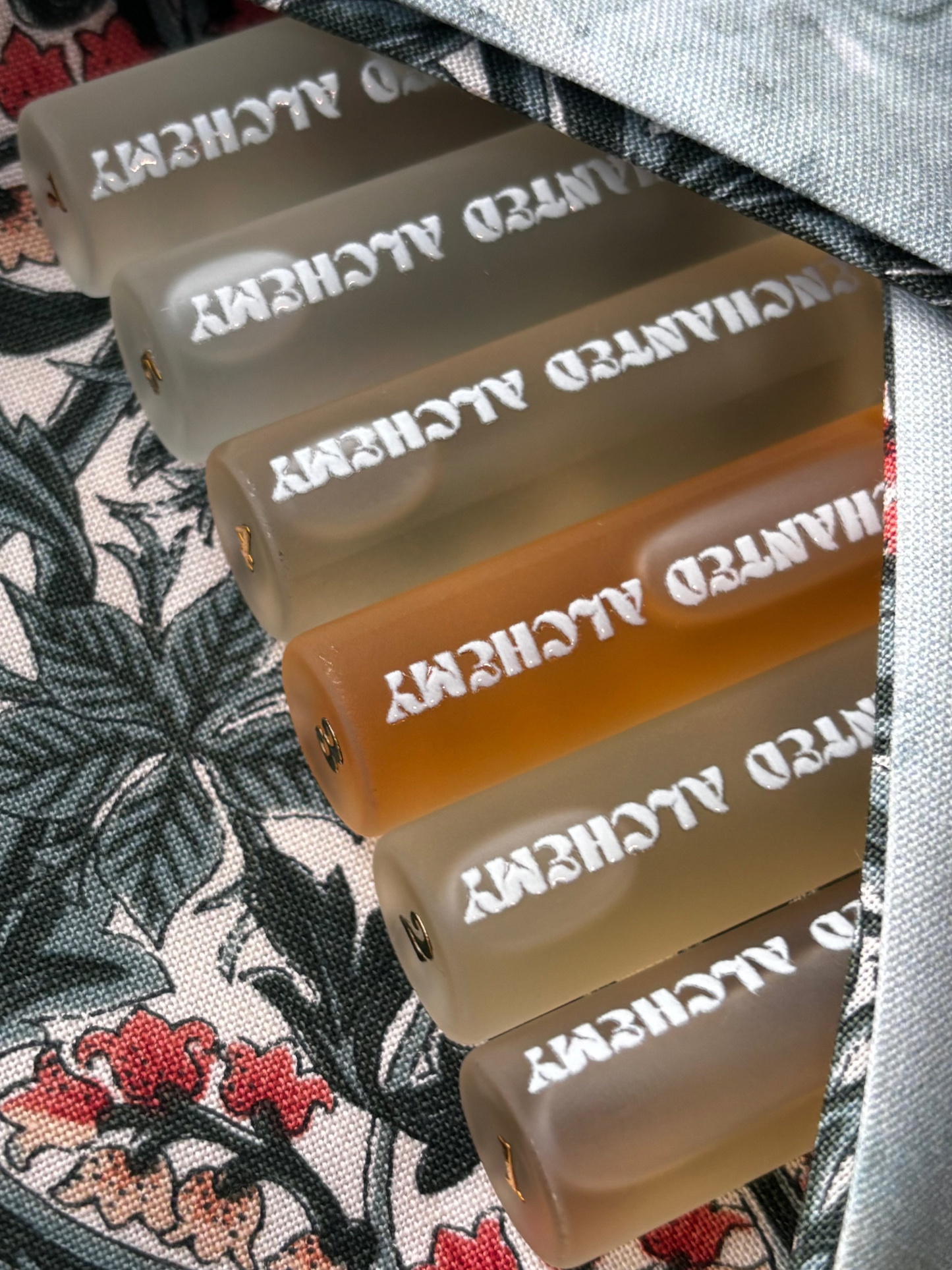
I hand-select natural absolutes, rare powders, and clean, non-toxic synthetic oils that carry the exact molecular weight required to speak to the nervous system. Hand-pouring in small, deliberate batches isn't just a production choice—it is a commitment to intentionality, beauty, and stillness. When a bottle leaves my hands, it carries an intimate, preserved moment meant to give you space to pause, reflect, and meet yourself.
We deliberately do not give our core collection romanticized names. We offer them as numbered artifacts so the bottle remains a clean slate—unburdened by outside expectations, ready for your nervous system to write its own story upon it. 
Integrating the Science: The Practice of Olfactory Anchoring
When you introduce a complex, clean formulation—like the warm, enveloping security of a cooked rice accord, the sharp clarity of cracked cardamom seeds, or the deep, ancient stillness of tree resins and black amber—you are handing your limbic system a physical tool.
If you want to use your artifact as a functional anchor for your own nervous system, try this ritual:
-
Choose Your Artifact: Select a numbered blend whose base notes evoke grounding or safety for you.
-
Create the Environment: Sit quietly for three minutes. Standardize your breathing—inhale for four counts, hold for four, exhale for six.
-
Apply the Anchor: Bring the artifact to your wrists, close your eyes, and inhale deeply.
By pairing the unmediated biological pathway of scent with intentional somatic stillness, you actively train your brain. Over time, your amygdala begins to associate that specific molecular footprint with safety. The next time the world feels loud or you hit an invisible wall of overwhelm, you only need to lift your wrist. The Olfactory Bypass will do the rest, bringing your nervous system back home before your conscious mind even has to ask.
In our next entry of The Neural Artifacts, we will explore Olfactory Anchoring & Trauma
Thank you for joining on this journey of diving deep into our psychology through perfumery. It will forever be an interesting and intriguing subject of mine.
Artwork By Loie Hollowell
Titled: The pit and the pendulum in blue, 2025